
In September 2025, I set myself the challenge of writing 500 words every day for the month. My first motivation was to support Refugee Action, a UK charity, as part of their ‘Race for Refugees’ campaign. By choosing a word goal rather than a distance to run, I also wanted to give my own writing habit a kick-start. (The specific fundraising page I set up is no longer active, but you can support Refugee Action here.)
Was I successful? My month wasn’t perfect, but I kept going, missed only a few days, and on days when I didn’t do the full 500 words I came very close.
At the end of the month, I jotted down my lessons learned. (Or relearned – we have to keep reminding ourselves of the value of good habits, don’t we?) So I’m sharing them here, in case it encourages you, or reminds you, of what’s worth comitting to in your own writing. What I learned might answer one or more of these questions for you:
- Is 500 words a day enough for a serious writing practice?
- How much time should I spend writing each day?
- Is an arbitrary word count goal worth it?
- Is a project word goal more important than a daily word goal?
- What is a sustainable writing habit?
- How can I fit a daily writing habit into my busy life?
- How can I build self-trust?
These are the lessons I learned, based on my own capacity and experience. Your mileage may vary, of course. But I am not good at consistency and routine! So read on for encouragement…
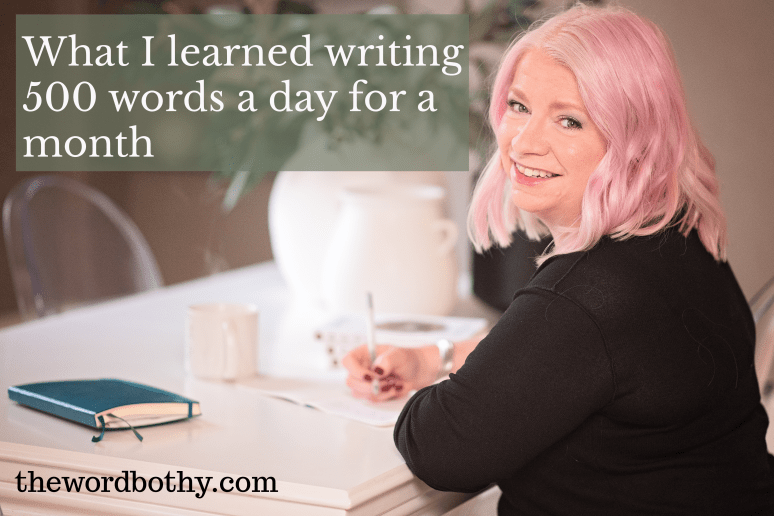
- 500 words was very doable in a busy day, amid the following list of ‘life’ going on around me in September: construction work at home involving daily decision-making chats with the builder; plumbers and electricians coming and going; spending time with friends visiting from abroad; travelling to attend a conference; doing the last few intense rehearsals for a play; my other half spontaneously deciding to work from home; catching a cold; a phone call from school about a sick kid; a big life decision that came at us from out of nowhere; loss of sleep due to pet trauma and just being a midlife woman; hormonal brain fog… With all that going on I was constantly adapting my schedule and the space I take up, moving my laptop to another part of the house, or grabbing a notebook to take on the run. I sat by the side of a pool during swimming lessons, while getting fresh air between conference sessions, on a train. Sometimes I wrote by appointment – during my Creative Coffee sessions or other people’s content create-alongs – but most often I wrote in the half-hour after dinner, while someone else was doing dishes (the silver lining of always cooking) and another someone else was walking the dog. (There was actually something delicious about that, declaring after dinner ‘I’m going to my room’, like a teenager retreating from family scrutiny.) Then, half an hour later, I still had the rest of the evening to finish other work, or watch TV.
A few days into September, I could have said to myself, ‘Nope, there’s too much going on.’ If my goal had been bigger, oh, let’s say 1667 words, I probably would have succumbed to life’s demands crowding in around the words. But I knew that really, every month is like that. Every month has life lifing away, sometimes with less urgency, but always with its demands. So when I kept going, it was deeply satisfying to know that I could almost always fit that half-hour in somewhere. - Yes, half an hour was enough to write 500 words. Even writing by hand, as long as I didn’t let myself pause to overthink the next word, and as long as I didn’t let myself mentally revise the sentence before, I could keep going and fill the page. It wasn’t cheating to write ‘bad’ words that were absolutely over-written, or that would objectively need to be corrected or deleted. It was the practice of writing down an idea and moving on to the next one that was so powerful. Every ‘bad’ word contributed to building that practice.
- 500 words was just the right amount to keep a habit going. Knowing that it could easily be achieved in one short session – or at most with an added 5 or 10 minutes snatched later in the day, meant I didn’t procrastinate. It was just long enough to get into what I was writing with a degree of depth, even if I’d want to build on it later.
- Some days I kept going, but most days I stopped writing soon after reaching the target. This was helpful in two ways: I could stop mid-sentence and give myself an easy way back in the next day. And by keeping the sessions short I was training myself to keep coming back – resistance was quieter when there wasn’t the background hope or expectation of a longer writing session.
- It was important to reset the word count each day. If I was short of the target one day, I didn’t add the deficit to the next day. If I missed a day, I didn’t double up or add an extra day to the end of the month. On a busy day, if I’d started thinking ‘Oh, and I’ve got to catch up and write 900 words today,’ I probably wouldn’t have even started. The total number of words wasn’t the goal. A daily practice that I could trust myself to stick to without resentment was the goal.
- For that reason, restarting or rewriting words from the day before wasn’t cheating either. All the words still counted. The rewrite wouldn’t have happened without the first attempt. I often think of each daily practice session as a brick in a wall, making it stronger, even (especially) when those bricks are creating the invisible foundations of my work.
- An arbitrary word count goal isn’t a ‘finishing’ tool for me. When I know I have a number of words to hit, that’s all I focus on. That’s brilliant for getting something started, and for building a habit. It silences the inner editor and keeps me moving forward. It’s less useful in the slower, more thoughtful stages of revising and publishing. Our writing tools only need to come out of the toolbox when they are most appropriate for the job at hand.
- Similarly, a daily word count – rather than a project goal – means ideas can be very quickly be processed into words and a draft. But it also means lots of different scraps of ideas and drafts, and less progress on a specific project.
- A daily word goal motivated me to capture thoughts and ideas that would otherwise have slipped in and then straight out of my mind. For example, I was inspired at a conference to draft my pitch for a future conference session, and at the end of the month I used my words to take notes for this post.
These are my lessons from sticking to the arbitrary goal I chose. If any of this has you inspired, maybe it’s time for you to set yourself a word goal – as low as it needs to be for you to build a daily habit, and with the frequency you can sustain. For me, it was 500 words every day; for you, it could be 100 words every weekday. Or 250 words every time you have a day off from the day job.
If you are looking for added accountability to write 500 words a day, you could start with Memoir Nation, a memoir writing community which is running JanYourStory, a challenge for any writer to write 500 words a day through the month of January. At the time of writing, there are a few days left of January 2026, but they welcome participants to join any time and will likely be running it in future years. Lots of other writing communities offer similar challenges so you can get that social support.
And if you’re thinking, ‘Nah, 500 words a day is nowhere near enough. I have to write much more than that to finish my novel/build a proposal/write meaningful articles,’ then bear this in mind: my total of words written in the month was 13498. That’s 13k more words than I would have had otherwise. And 13k words that would not exist if I’d told myself I had to sit down for hours every day and write thousands of words.
So maybe it’s time to start small. Because it’s a start.
(If you have well and truly started, and are on the way to that revising and publishing stage with your novel or memoir, keep me in mind for your copyediting needs! Click here to get my free indie author self-editing checklist, and I’ll keep in touch with my availability updates. You’ll also get useful posts like this one right in your inbox.)
 The Word Bothy